

Did you know that three out of four people who use Google never scroll past the first page? If your website doesn’t rank high, most people who might want to buy something from you might not even see it.
A lot of businesses have trouble showing up in search results because they don’t follow basic SEO Principles. Websites that don’t have a clear plan often get lost in the competition, which costs them traffic and leads. This confusion makes business owners angry and confused about why their online efforts don’t work.
At Phoenix Dial, our team of SEO experts uses tried-and-true methods to make websites more useful and easier to find. We take care of everything, from looking up the best keywords to making your website faster, better structured, and with better content, to make sure it gets the right visitors and ranks higher in search engines. We know how to help businesses grow online steadily, without having to guess what works.
In this article, we’ll go over the most important SEO Principles, explain how they work, and give you useful tips on how to make your website more visible and reach more customers online.
What Are SEO Principles?
SEO principles are the main rules and best practices that help websites show up higher on search engines like Google. These are easy-to-follow rules that help both people and search engines understand your website better. Think of them as the building blocks of any successful online presence.
How SEO Works in Simple Steps:
SEO helps people find your website when they are looking for products or services that you offer. In easy steps:
- Research: Find the words people type into Google.
- Optimize Content: Use these words naturally in your website pages.
- Improve Website Structure: Make your site easy to navigate for both users and search engines.
- Build Authority: Get other trusted websites to link to your site.
- Monitor & Improve: Track results and make changes to keep growing.
Difference Between SEO Principles and SEO Tools:
SEO tools are programs or platforms that help you use the rules and strategies of SEO. For instance, principles tell you how to use keywords wisely, and a tool like Google Keyword Planner helps you find the right ones. Tools can change or get better over time, but principles stay the same.
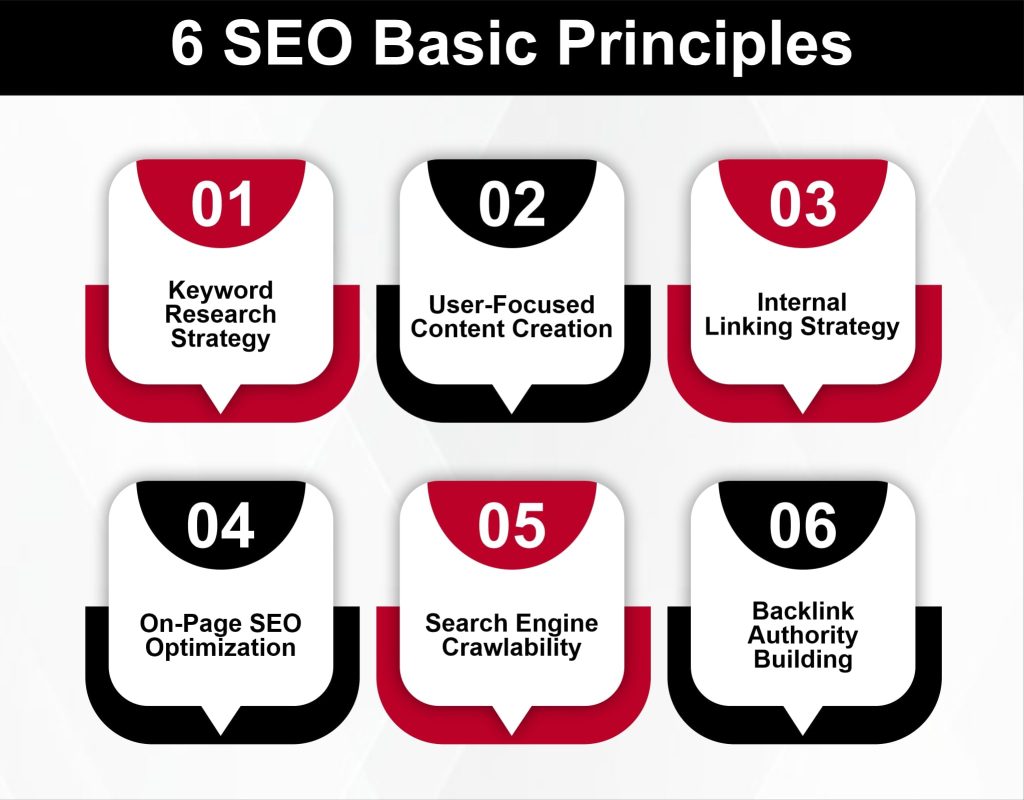
6 SEO Basic Principles
The first step to making your website more visible is to learn the basics of SEO. These simple rules will help you make a website that search engines can easily read and that people will like visiting. Even people who are just starting out can grow their online presence well by following these basic steps.
Here are the six most important SEO basics that every website should pay attention to:
Keyword Research Strategy
The first step in SEO is to do keyword research. It helps you figure out what words or phrases people type into search engines. Using the right keywords makes sure that the right people see your content.
How to do it:
- Use Google Keyword Planner or Ubersuggest to find out what people are searching for a lot.
- For beginners, focus on keywords that get a lot of searches but don’t have a lot of competition.
- Use these keywords in your titles, headings, and content in a natural way.
Example:
If you run a bakery, keywords like “best chocolate cake near me” or “easy cupcake recipes” help attract visitors looking for exactly what you offer.
User-Focused Content Creation
One of the most important things for SEO is to make content that users will want to read. Search engines give higher rankings to websites that have content that is useful, clear, and interesting.
Tips for user-focused content:
- Answer common questions or solve real problems.
- Make sure that your sentences are short and your paragraphs are short.
- To make your content easier to understand, add pictures, examples, or steps.
Example:
A blog explaining “how to fix a leaking faucet” with step-by-step images will rank better than vague instructions.
Internal Linking Strategy
Connecting one page of your website to another is called internal linking. It helps people find more content and helps search engines figure out how your site is set up.
How to do it:
- In your content, naturally link to related blog posts or service pages.
- Use descriptive anchor text to tell people what the page is about.
- Don’t put too many links on a page.
Example:
A post about “basic SEO tips” can link to another post about “SEO optimization basics” for more detailed guidance.
On-Page SEO Optimization
On-page SEO means making sure that each page follows the basic rules of SEO. It makes sure that both search engines and people can easily understand your content.
Key on-page steps:
- Put your main keyword in the first paragraph, the title, and the headings.
- Use descriptive alt text to make images better.
- Add meta tags that tell people what the page is about.
Example:
A service page for “digital marketing services” should have that keyword in the title, headings, and naturally in the content.
Search Engine Crawlability
One of the most important SEO basics is to make your website easy for search engines to crawl. Bots from search engines read your site, and if they can’t figure out how to get around it, your pages won’t show up in the search results.
Tips to improve crawlability:
- Make sure your menu and site structure are clear.
- Send a sitemap to Google Search Console.
- Don’t use links that don’t work or content that is the same as other content.
Example:
A well-organized website with pages like Home → Services → Contact makes it easy for both users and Google bots.
Backlink Authority Building
Links from other websites to yours are called backlinks. They are an important part of basic SEO because they tell search engines that your content is reliable.
How to build authority:
- Make content that is useful and of high quality that other people will want to use.
- Get in touch with other blogs or websites that are similar to yours to work together.
- Don’t click on links that look like spam; instead, look for real, useful sources.
Example:
If a popular food blog links to your bakery recipes, it signals authority to Google and improves your rankings.
Why Do SEO Fundamentals Matter for Visibility?
To make your website easy to find, you need to know the basics of SEO. If you do SEO the right way, search engines like Google will know what your site is about and show it to people who are looking for your goods or services. Even a great website can stay hidden without these basics.
Difference Between Visible and Invisible Websites:
A website that is easy to find gets traffic, makes leads, and earns users’ trust. No matter how well-designed it is, an invisible website won’t show up in search results. You can make a site that no one can see stand out online by using basic SEO techniques like using the right keywords, optimizing your content, and making your site easy to navigate.
Long-Term Benefits of SEO:
Using SEO principles isn’t just for quick results; they also help you in the long run. A site that is well-optimized keeps getting visitors, builds authority, and makes the site more trustworthy. Paid ads stop bringing in traffic when the campaign ends, but SEO basics keep your business visible and help it grow over time.
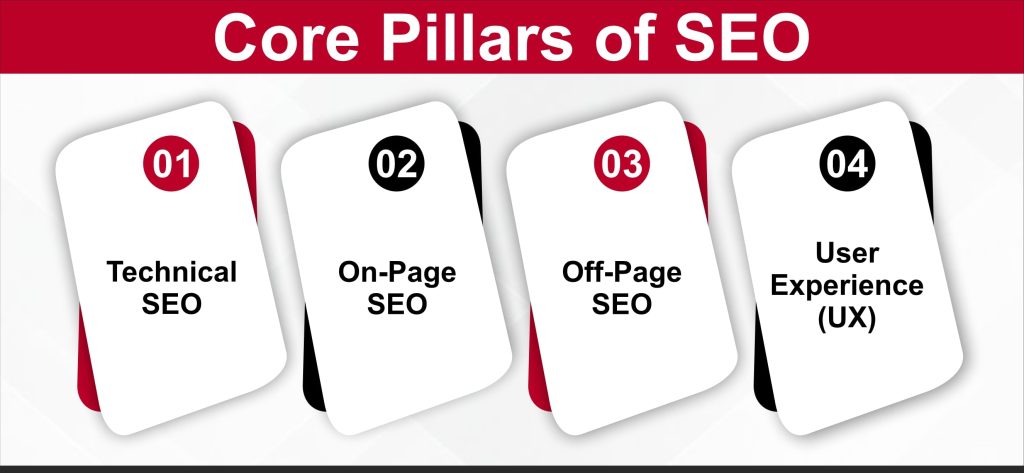
Core Pillars of SEO
The core pillars of SEO are the foundation of a strong and successful website. These pillars are the foundation of all SEO Principles and help search engines understand, rank, and trust your site. You can reach the right audience and get more exposure when you follow them correctly. These ideas are part of basic SEO and are easy to understand, even for people who are new to it.
The four main pillars that make up the basics of SEO are listed below.
Technical SEO
Technical SEO is all about how search engines find and read your site. Search engines need to know what your site is about before they can rank it, so this is an important part of SEO basics.
Website speed, mobile-friendliness, secure connections, and a clear site structure are all part of this pillar. When these things work well, search engines can easily crawl and index your pages. This helps with the basics of SEO and makes everything work better.
On-Page SEO
The goal of on-page SEO is to improve the content and parts of a page. It is one of the most important basics of SEO and helps search engines figure out what each page is about.
This means using keywords in a natural way, making headings that are easy to read, optimizing images, and making the content better. By following these basic SEO tips, your pages will be more useful and relevant to users.
Off-Page SEO
Off-page SEO is all about building trust and authority outside of your website. It is a key part of SEO and tells search engines that your site is trustworthy.
Getting high-quality backlinks from websites that are related to yours is the main goal of this pillar. Using basic SEO knowledge, strong off-page signals can help your credibility and long-term growth.
User Experience (UX)
User experience is all about how easy and enjoyable it is to use your website. It is very similar to what SEO principles say and is very important for rankings.
This includes easy-to-use navigation, clear layouts, readable content, and a design that works on mobile devices. A good user experience is good for SEO basics and helps you get more visibility over time.
Common SEO Mistakes Beginners Should Avoid
A lot of beginners have trouble with SEO because they don’t know the basics and do things wrong. These mistakes can make it harder to see and slow down growth. Knowing the basics of SEO can help you avoid mistakes and build a solid base. It’s important to learn about these problems early on in your basic SEO education.
Here are some common mistakes that go against the basics of SEO and should be avoided.
Keyword Stuffing
When you put too many keywords in your content, that’s called keyword stuffing. This practice goes against good SEO Principles and makes content hard to read. Search engines care more about quality and relevance than how many times a word is used.
Putting keywords in the right places and focusing on helpful content are two important parts of SEO. Using keywords in a balanced way makes things easier to read and helps them stay visible over time.
Copying Content
It is not good for SEO to copy content from other websites. Search engines like content that is new and useful to users. Having the same content on multiple pages lowers trust and hurts rankings.
Making unique content that clearly explains your message is one of the most important things to do for SEO. Original content builds authority and boosts SEO performance as a whole.
Ignoring Mobile Users
In basic SEO, it’s a big mistake to ignore mobile users. People mostly search on their phones, and search engines give priority to websites that work well on mobile devices.
One of the basics of SEO is making sure that your website works well on all screen sizes and is easy to use. Mobile optimization is a big part of SEO principles and helps make things easier to find.
Conclusion
To have a strong online presence, you need to know and use SEO principles. When you follow the basic rules of SEO, search engines will trust your site more, and it will be easier for people to find and use. Over time, small things like focusing on good content, a good structure, and a good user experience can make a big difference.
Beginners can avoid making common mistakes and grow steadily without getting confused by learning the basics of SEO. There are no shortcuts in SEO. It has to do with being consistent, clear, and valuable. When you use basic SEO knowledge correctly, your website gets more traffic, attracts the right people, and helps your business grow over time.
Phoenix Dial is here to help you use these basic SEO techniques correctly if you need help from an expert. We are a digital marketing company that focuses on services. Our skilled SEO team helps businesses grow by using smart, ethical, and results-driven SEO strategies. Check out our website to find out how we can help you get more traffic, higher rankings, and more success online.
FAQ’s
What are the 4 pillars of SEO?
The four pillars of SEO are Technical SEO, On-Page SEO, Off-Page SEO, and User Experience. Together, they follow core SEO principles that help websites rank better and stay visible.
What are the 5 important concepts of SEO?
The five important concepts include keyword research, quality content, on-page optimization, backlinks, and user experience. These are part of SEO fundamentals and guide how search engines rank pages.
What are the 5 crucial elements of SEO?
The five crucial elements of SEO are relevant keywords, helpful content, technical website health, backlinks, and mobile optimization. These elements support basic SEO and improve long-term visibility.
What are the top 5 SEO strategies?
The top SEO strategies include targeting the right keywords, creating user-focused content, optimizing pages, building quality backlinks, and improving site speed. These strategies align with SEO basics and drive steady growth.