

AI SEO is now changing how search engines rank websites. Google and other search platforms use artificial intelligence to understand what people really want when they search online. They no longer look at keywords alone. They look at meaning, intent, and content quality. The problem is that many websites still use old SEO methods. They focus only on keywords and links. Because of this, their rankings drop and traffic slows down. This creates confusion and frustration for business owners who want results.
At Phoenix Dial, we solve this problem with smart AI SEO strategies. Our expert team studies user behavior and search intent. We create clear, helpful content that both users and AI understand. This helps businesses rank higher and attract the right visitors. In this post, we will explain what AI SEO is, why it matters today, and how you can use it to grow your website the right way.
What Is AI SEO and How Does It Work?
AI SEO means using artificial intelligence to improve how a website appears in search results. It helps search engines understand content the same way people do. Instead of only reading keywords, AI looks at meaning, context, and user intent. This makes search results more useful for users.
AI helps search engines understand content by studying how people search, click, and read pages. It learns which content answers questions clearly and which content users ignore. Because of this, AI prefers pages that are helpful, easy to read, and well-structured. Content that solves real problems performs better.
The main difference between traditional SEO and AI SEO is the focus. Traditional SEO mainly depends on keywords, links, and technical rules. AI SEO focuses on users, intent, and content quality. AI SEO rewards websites that provide clear answers and a good user experience, not just keyword placement.
Why AI SEO Matters for Modern Websites
AI SEO matters for modern websites because the way people search online has changed. Users no longer type short keywords. They ask full questions and expect clear answers. Search engines now use AI to understand these searches and show the most helpful content first. Websites that fail to match this behavior lose visibility.
Voice search and smart assistants also play a big role today. People speak naturally when using mobile phones or smart devices. AI SEO helps search engines understand spoken queries and user intent. Websites with clear and simple content perform better in voice-based searches.
Businesses must adapt now because AI-driven search is not a future trend. It is already here. Companies that ignore AI SEO struggle to rank and lose potential customers. Those who adapt early gain better visibility, trust, and long-term growth.
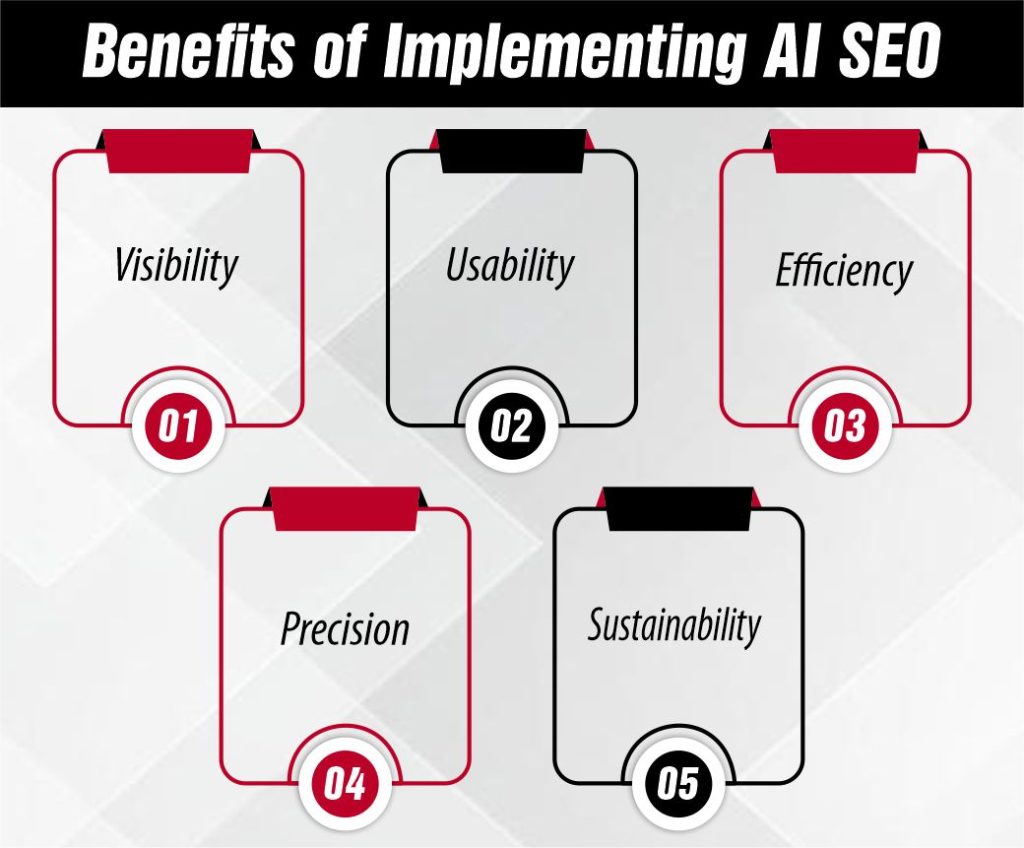
Benefits of Implementing AI SEO
Implementing AI SEO offers many advantages for modern websites. It not only helps websites rank higher but also improves user experience, saves time, and ensures long-term growth. By using AI, businesses can focus on creating content that truly matches what users are looking for. AI SEO is smarter than traditional SEO because it understands user intent, context, and quality rather than just keywords.
Visibility
AI SEO improves visibility by making your content easier for search engines to understand. When AI recognizes that your content is helpful, relevant, and answers user questions, your pages appear higher in search results. This means more people can find your website naturally, without paid ads. Higher visibility also increases brand awareness and builds trust with potential customers, helping your business stand out in a crowded online space.
Usability
AI SEO enhances usability by encouraging content that is clear, organized, and easy to read. Search engines now reward websites that are user-friendly. This includes well-structured headings, bullet points, simple language, and quick-loading pages. When users can easily find the information they need, they spend more time on your site. Better usability reduces bounce rates, increases engagement, and creates a positive experience that keeps visitors coming back.
Efficiency
AI SEO brings efficiency to website optimization by using intelligent tools to analyze large amounts of data quickly. Instead of manually checking every page or keyword, AI identifies opportunities, highlights weak areas, and suggests improvements. This saves businesses a lot of time and resources. Teams can focus on creating high-quality content while AI handles repetitive analysis, making SEO faster and more effective than traditional methods.
Precision
AI SEO adds precision by understanding exactly what users want when they search. It goes beyond keywords and looks at search intent, context, and content relevance. This allows your website to reach the right audience at the right time. With precise targeting, visitors are more likely to find your solutions useful and take action, whether that means signing up, buying a product, or contacting your team.
Sustainability
AI SEO ensures sustainability for long-term website growth. By focusing on helpful, high-quality content and a great user experience, your site remains relevant even as search engines update their algorithms. This reduces the need for constant fixes or penalties. Over time, AI SEO builds a strong foundation that supports consistent traffic, leads, and business growth, making your online presence future-proof.
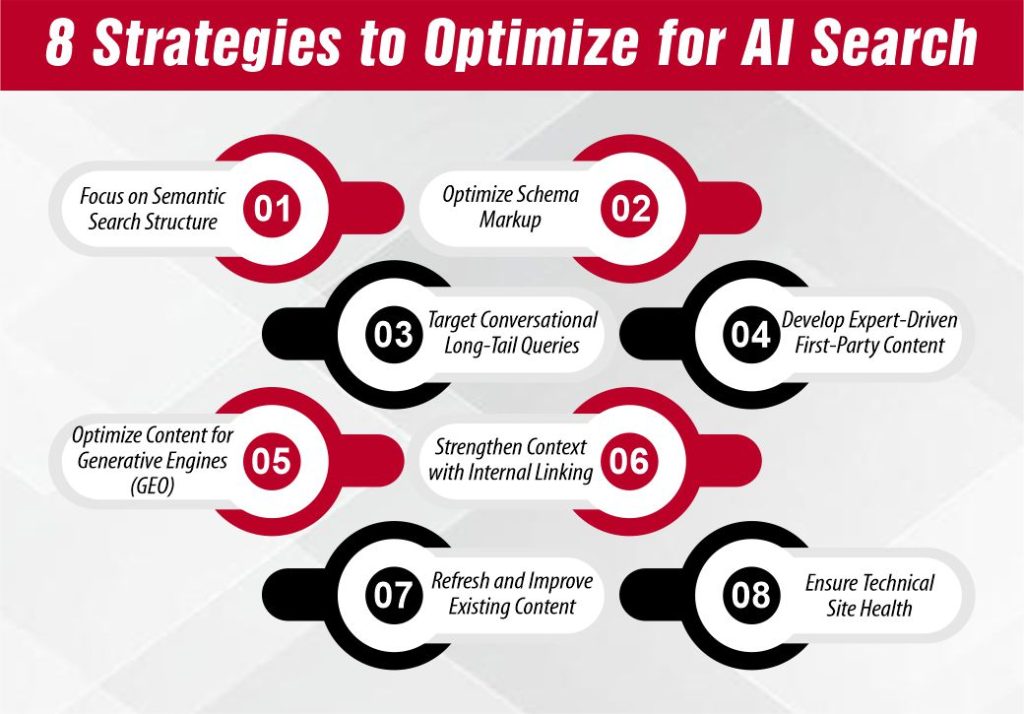
8 Strategies to Optimize for AI Search
Optimizing for AI search is different from traditional SEO. Modern search engines use AI to understand content, user intent, and context. To rank well, websites must focus on meaning, relevance, and quality. Here are 8 strategies to help your website perform better in AI-driven searches.
Focus on Semantic Search Structure
AI search is smart—it looks at the meaning of your content, not just exact keywords. Instead of repeating the same word over and over, organize your content around main topics and related ideas. Use clear headings, subheadings, bullet points, and short paragraphs. This structure makes it easier for AI to understand what your page is about and helps it match your content with user queries more accurately. Semantic organization also improves readability, keeping visitors engaged longer.
Optimize Schema Markup
Schema markup is a type of code that tells search engines exactly what your content represents. It can describe articles, products, reviews, events, or FAQs. Adding schema helps AI interpret your page better and can create rich snippets in search results. Rich snippets improve click-through rates because they make your content stand out with extra information like ratings, dates, or summaries. Proper schema increases visibility and ensures your content gets recognized correctly by AI systems.
Target Conversational Long-Tail Queries
People now search in natural language, asking questions like “How do I improve my website for AI search?” instead of typing single keywords. Focusing on long-tail, conversational queries aligns your content with the way AI interprets searches. These queries are more specific and attract visitors who are ready to take action. By answering real questions, your website becomes more helpful and ranks higher in AI-powered search results.
Develop Expert-Driven First-Party Content
AI prefers content that shows authority, originality, and trust. First-party content—like original articles, guides, case studies, or data—demonstrates your expertise. Avoid copying content from other websites because AI can detect duplicate or low-quality material. High-quality, expert content signals credibility, which improves rankings and encourages users to trust your website. Consistently producing authoritative content positions your business as a reliable source.
Optimize Content for Generative Engines (GEO)
Generative AI engines, like those used in chatbots or AI assistants, summarize and answer questions using content from the web. To take advantage of this, create content that is clear, structured, and concise. Highlight key points with headings and lists, and answer common questions directly. When AI can easily extract your content, your pages are more likely to be featured in AI-generated answers or summaries, bringing more visibility and traffic.
Strengthen Context with Internal Linking
Internal links connect related pages on your website. They help AI understand the structure of your site and how topics relate to each other. Internal linking also guides users to other helpful pages, improving their experience and engagement. When AI sees strong connections between content, it boosts the relevance of your pages and helps your website rank better overall.
Refresh and Improve Existing Content
AI prefers content that is up-to-date and relevant. Regularly review older pages and improve them with new information, clearer headings, better formatting, and updated data. Refreshing content signals to search engines that your website is active and authoritative. Over time, this maintains or improves your rankings and ensures visitors always find accurate, valuable information.
Ensure Technical Site Health
Even the best content cannot perform well if your website has technical problems. Make sure your site loads quickly, is mobile-friendly, has HTTPS security, and contains no broken links or errors. Technical health allows AI to crawl and index your site efficiently. A technically sound website improves user experience, reduces frustration, and ensures your pages have the best chance to rank in AI-driven search results.
How to Measure AI SEO Success
Measuring AI SEO success is essential to know if your efforts are working. AI SEO is not just about ranking for keywords—it’s about improving visibility, user experience, and driving meaningful results. To see if your strategies are effective, you need to track performance regularly and focus on key indicators that show real impact.
Track Organic Traffic Growth
One of the simplest ways to measure AI SEO success is by monitoring organic traffic—the number of visitors coming from search engines. If AI SEO strategies are working, your traffic should increase steadily over time. Tracking organic traffic helps you see whether your content is being discovered by the right audience and attracting more potential customers.
Check Keyword Ranking Improvements
Even though AI SEO focuses on intent and context, keyword rankings still matter. Monitor how your primary topics and long-tail queries rank over time. Improvements in rankings indicate that AI search engines understand your content better. Tracking rankings helps identify which pages are performing well and which need optimization.
Monitor User Behavior Like Time on Page
AI evaluates how users interact with your website. Metrics like time on page, bounce rate, and pages per session show how useful your content is. Longer time on page and lower bounce rates suggest that visitors find your content helpful. Monitoring these behaviors helps you understand what’s working and what needs improvement for AI SEO.
Measure Conversion Rates
Traffic alone is not enough. Measure conversion rates to see how many visitors take desired actions, like signing up for a newsletter, requesting a quote, or making a purchase. High conversion rates show that AI SEO is attracting the right audience and that your content is guiding users effectively toward your goals.
Use Simple Tools Like Google Search Console
You don’t need complex software to measure AI SEO success. Tools like Google Search Console are free and easy to use. They provide insights into traffic, impressions, click-through rates, and keyword performance. Using these tools helps you track progress, identify opportunities, and adjust your AI SEO strategies for better results.
Common AI SEO Mistakes to Avoid
While AI SEO can greatly improve your website performance, many businesses make simple mistakes that limit results. Ignoring how AI interprets content or focusing only on old SEO rules can reduce traffic, engagement, and conversions. Knowing the common mistakes helps you fix issues before they hurt your rankings.
Writing for Bots Instead of People
One major mistake is creating content only for search engines. Writing just to “please AI” or force keywords can make content unnatural and hard to read. AI SEO works best when your content is helpful and clear for humans first. Focus on providing real value to your audience while keeping AI in mind.
Using Hard or Confusing Words
Using complex terms or jargon can confuse both users and AI. Simple, easy-to-read language improves comprehension and keeps visitors engaged. AI also favors content that is clear and structured. Avoid unnecessary technical words unless your audience expects them.
Ignoring User Questions
Users search online with questions. Ignoring these queries is a common mistake. AI SEO prioritizes content that answers real questions and provides solutions. Including FAQs, clear explanations, and step-by-step guidance helps your content match what people are actually looking for.
Not Updating Old Content
Old content can quickly lose value if it isn’t updated. Failing to refresh pages with new information, improved formatting, or better headings can reduce rankings. AI favors fresh, relevant, and accurate content, so regularly updating your website keeps it competitive and authoritative.
Conclusion
AI SEO is no longer optional—it is the future of search engine optimization. By focusing on user intent, clear content, and smart strategies, websites can rank higher, attract the right audience, and grow sustainably. Implementing AI SEO helps businesses improve visibility, usability, efficiency, precision, and long-term performance.
Avoid common mistakes like writing only for bots, using confusing words, ignoring user questions, or leaving old content outdated. Instead, follow proven strategies, monitor performance, and continuously optimize your website for AI-driven searches.
If you want to get expert help with AI SEO and grow your online presence, Phoenix Dial has a skilled team ready to create strategies that deliver real results. Visit Phoenix Dial today to learn how we can help your business rank higher, reach more customers, and stay ahead in the AI-powered search world.
FAQ’s
Is AI SEO different from normal SEO?
Yes, AI SEO focuses on user intent, context, and content quality, while normal SEO mainly focuses on keywords and links. It uses artificial intelligence to understand and rank content smarter.
Do small businesses need AI SEO?
Absolutely. AI SEO helps small businesses compete online by improving visibility and attracting the right audience without relying solely on paid ads.
Can AI SEO help new websites?
Yes, AI SEO guides new websites to create helpful, well-structured content that ranks faster and reaches the right users.
How long does AI SEO take to show results?
Results usually start appearing in a few weeks, but significant improvements can take 3–6 months depending on competition and website size.