

Businesses now use data every day to reach the right people faster, and this is where AI in Digital Marketing plays a key role. Companies collect data from websites, ads, emails, and social media, but many struggle to understand what this data really means. This confusion leads to poor targeting, wasted ad spend, and slow growth. Without the right system, teams spend hours on manual work and still miss good opportunities.
At Phoenix Dial, our expert team uses smart AI-driven strategies to study data, track user behavior, and turn insights into clear marketing actions. We help businesses make better decisions, save time, and improve results. In this post, you will learn how AI works in digital marketing, why it matters today, and how businesses can use it to grow faster and smarter.
What is AI in Digital Marketing?
AI in Digital Marketing means using smart technology to help businesses plan, run, and improve their marketing work. AI studies data, learns from user actions, and makes decisions faster than humans. It helps marketers understand what people like, what they search for, and how they behave online.
This approach allows digital marketing tasks to become more accurate and less manual. AI can help with content creation, audience targeting, ad optimization, and performance tracking. It works by analyzing large amounts of data and finding patterns that humans may miss.
In simple terms, AI helps marketers work smarter. It supports better planning, faster execution, and improved results. This is why digital marketing and AI now work closely together in modern marketing strategies.
The Role of AI in Modern Digital Marketing
AI in Digital Marketing plays an important role in helping businesses grow in a fast online world. AI matters because it helps companies understand data quickly and take the right action at the right time. Many businesses deal with large amounts of data every day, and AI makes this data useful and easy to manage.
AI supports faster decision-making by studying user behavior in real time. It helps marketers see what is working and what is not without delay. This allows teams to adjust ads, content, and campaigns quickly and avoid wasting money.
AI also improves the customer experience by delivering relevant content and offers. It helps brands show the right message to the right person. This makes users feel understood and increases trust. When people see content that matches their needs, they engage more.
Another key role of artificial intelligence in digital marketing is improved marketing accuracy. AI reduces guesswork by using data and patterns. It helps businesses target the right audience, improve results, and plan better marketing strategies.
How AI Is Used in Digital Marketing
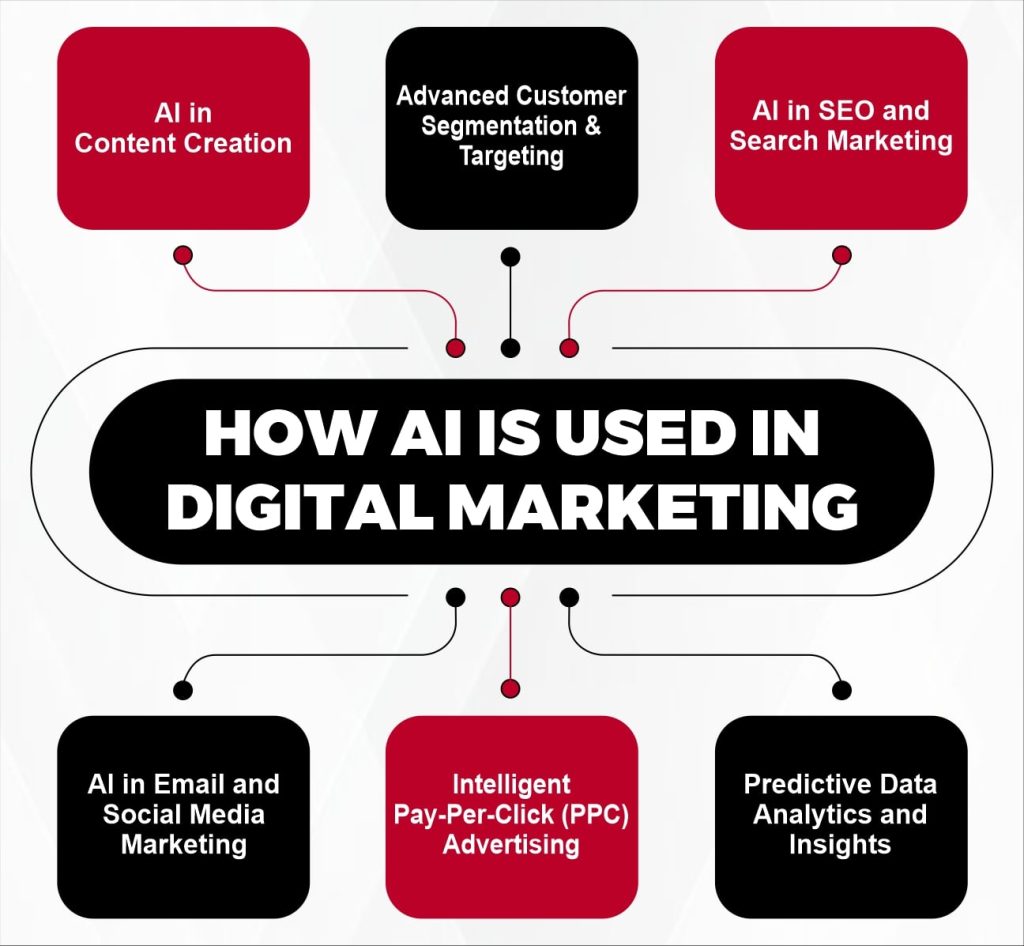
AI in Digital Marketing is no longer just a trend—it’s a powerful tool that helps businesses work smarter and faster. From creating content to running ads, AI can handle repetitive tasks, analyze large amounts of data, and provide insights that improve decision-making. By using AI, marketers can reach the right audience, optimize campaigns, and achieve better results with less effort.
AI in Content Creation
AI in digital marketing plays a major role in content creation. It helps marketers generate high-quality content faster and more efficiently. AI can create blog drafts, social media posts, product descriptions, and even ad copy by analyzing audience preferences, trending topics, and search behavior.
With ai content marketing, brands can consistently produce fresh and relevant content without relying entirely on human effort. AI also suggests improvements in tone, style, and readability, allowing marketers to refine content and make it more engaging. Using AI in digital marketing for content creation saves time, maintains quality, and ensures content resonates with the target audience.
Advanced Customer Segmentation and Targeting
One of the biggest benefits of AI in digital marketing is advanced customer segmentation and targeting. AI studies user behavior, past purchases, demographics, and browsing patterns to divide audiences into precise groups. This allows marketers to send personalized messages, recommend relevant products, and run targeted campaigns.
AI tools for digital marketing make this process faster and more accurate than traditional methods. By understanding each customer segment, businesses can increase engagement, improve conversion rates, and make the most of their marketing budgets. Marketing AI ensures that campaigns are not just broad but specifically designed for the right audience.
AI in SEO and Search Marketing
Artificial intelligence in digital marketing is transforming SEO and search strategies. AI analyzes search trends, competitor keywords, and user behavior to help marketers optimize their websites and content. Tools using generative AI in digital marketing can create SEO-friendly content, meta descriptions, and title tags quickly.
AI also predicts which keywords or content will perform best, monitors rankings, and identifies new opportunities to attract traffic. Using AI in SEO allows marketers to save time, improve accuracy, and make data-backed decisions that boost search visibility. By combining digital marketing and AI, businesses can stay ahead in competitive online spaces.
AI in Email and Social Media Marketing
AI helps marketers improve email and social media campaigns by predicting what type of content will engage each audience. It can suggest the best times to send emails or post on social platforms, optimize subject lines, and even write captions that attract clicks.
With ai digital marketing tools, marketers can automate these tasks while ensuring messages reach the right people at the right time. AI in digital marketing also tracks engagement and recommends changes for better results. This reduces manual work, increases campaign effectiveness, and provides a more personalized experience for users.
Intelligent Pay-Per-Click (PPC) Advertising
AI in digital marketing significantly enhances PPC campaigns. AI monitors ad performance, studies user behavior, and adjusts bids automatically in real time. It also suggests better ad copy, visuals, and audience targeting.
Using ai marketing for PPC reduces wasted spending, increases ROI, and ensures ads reach users most likely to convert. With AI, marketers can optimize campaigns continuously without constant manual intervention. Intelligent PPC powered by AI helps businesses get more value from every ad dollar and achieve precise targeting.
Predictive Data Analytics and Insights
One of the most powerful aspects of AI in digital marketing is predictive analytics. AI examines past customer behavior, campaign performance, and market trends to forecast what will happen next. With these insights, marketers can plan future campaigns, optimize budgets, and make smarter decisions.
AI tools for digital marketing allow businesses to anticipate customer needs, predict trends, and stay ahead of competitors. By using predictive analytics, marketers can reduce guesswork, improve marketing accuracy, and create strategies that deliver better results consistently.
Pros and Cons of AI in Digital Marketing
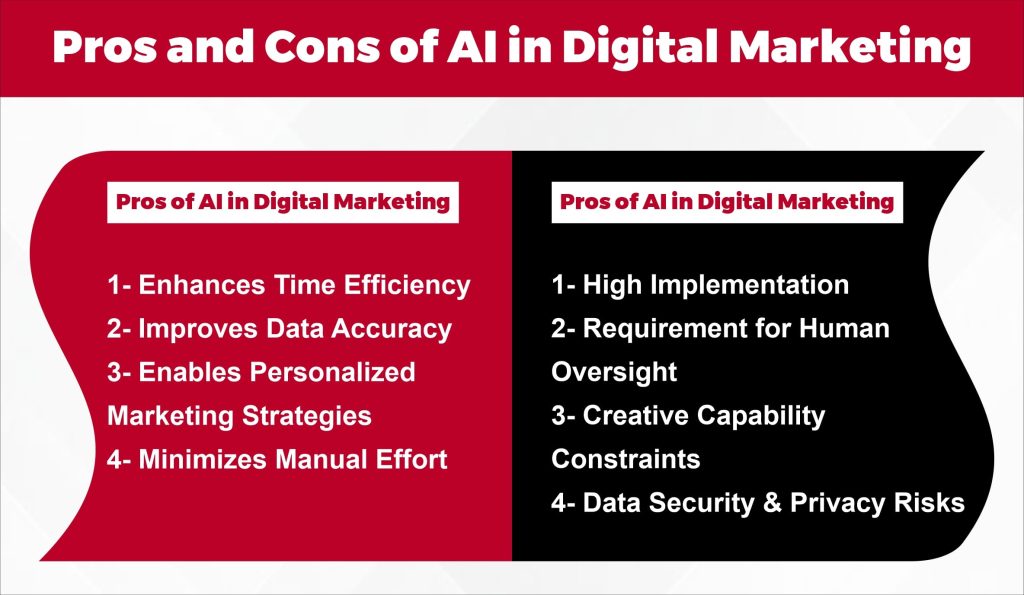
AI in digital marketing has become a crucial tool for modern businesses. While it offers many advantages, it also comes with challenges that marketers should be aware of. Understanding both the pros and cons of AI in marketing helps businesses use it effectively and avoid common pitfalls.
Pros of AI in Digital Marketing
Enhances Time Efficiency
One of the biggest benefits of AI in digital marketing is time efficiency. AI can automate repetitive tasks like content creation, email scheduling, and ad optimization. This allows marketers to focus on strategy and creative work instead of spending hours on manual processes. By using AI tools for digital marketing, businesses can accomplish more in less time without compromising quality.
Improves Data Accuracy
AI studies large amounts of data quickly and finds patterns that humans might miss. This improves marketing AI accuracy in predicting customer behavior, audience targeting, and campaign performance. Accurate data analysis ensures that decisions are based on facts, not guesswork, which leads to better results for every campaign.
Enables Personalized Marketing Strategies
AI digital marketing allows brands to deliver personalized messages and content to each user. By analyzing user behavior, preferences, and purchase history, AI can suggest the right products or content at the right time. Personalized marketing increases engagement, builds customer trust, and improves conversion rates.
Minimizes Manual Effort
Manual marketing tasks like posting on social media, sending emails, or tracking campaign results can be time-consuming. AI in digital marketing reduces manual effort by automating these processes. Marketers can focus on higher-level strategies while AI handles the routine tasks efficiently.
Cons of AI in Digital Marketing
High Implementation
One challenge of AI in digital marketing is the high cost and effort required to implement it. Businesses may need to invest in software, tools, and training to use AI effectively. For small businesses, this can sometimes be a barrier to adopting AI solutions.
Requirement for Human Oversight
While AI can automate many tasks, it still requires human supervision. AI for marketers cannot fully understand context, emotions, or subtle audience nuances. Without proper oversight, AI-generated content or campaigns may not align with brand values or marketing goals.
Creative Capability Constraints
AI is powerful in analyzing data and generating ideas, but it has limitations in creativity. AI content marketing may produce functional content, but it cannot fully replicate human creativity, storytelling, or emotional appeal. Marketers still need to guide AI to create unique and engaging campaigns.
Data Security and Privacy Risks
Using AI in digital marketing involves collecting and analyzing large amounts of customer data. This creates potential risks for data security and privacy. Businesses must follow regulations and take precautions to protect sensitive information when using AI-powered marketing solutions.
Challenges of Using AI in Digital Marketing
AI in digital marketing offers many benefits, but it also comes with challenges that businesses need to understand. Using AI effectively requires planning, skill, and careful management. Recognizing these challenges helps marketers avoid mistakes and get the best results from digital marketing and AI strategies.
Data Quality Issues
One of the main challenges of AI in digital marketing is data quality. AI relies on accurate, clean, and complete data to make decisions. If the data is incomplete, outdated, or incorrect, AI predictions and suggestions can be misleading. Poor data quality affects everything from audience targeting to content recommendations. To make the most of ai digital marketing, businesses must ensure their data is well-organized, reliable, and up-to-date.
Learning Curve for Beginners
Another challenge is the learning curve for beginners. Using AI tools for digital marketing requires understanding how the technology works and how to interpret AI-generated insights. For marketers who are new to AI, it can take time to learn the features, set up tools properly, and integrate them into campaigns. Without proper knowledge, businesses may not use AI to its full potential or could make errors in strategy.
Over-Dependence on Tools
Relying too much on AI in digital marketing can also be risky. While AI helps with analysis, automation, and optimization, it cannot replace human judgment completely. Over-dependence on AI tools may reduce creativity, critical thinking, and personal touch in marketing campaigns. Marketers should use AI marketing as a support system rather than a full replacement for strategy, ensuring a balance between AI insights and human decision-making.
Conclusion
AI has transformed the way businesses approach marketing. From creating content and analyzing data to personalizing campaigns and improving efficiency, AI in digital marketing offers many advantages. At the same time, it comes with challenges like data quality, learning curves, and the need for human oversight. By understanding both the pros and cons of AI in marketing and using it wisely, businesses can save time, reach the right audience, and make smarter marketing decisions.
If you want to leverage artificial intelligence in digital marketing to grow your business effectively, Phoenix Dial has a team of experts ready to help. Contact us today to learn how our AI-powered strategies can improve your marketing results and give your business a competitive edge.
FAQ’s
Can digital marketing be taken by AI?
AI can handle many digital marketing tasks like content creation, email campaigns, ad optimization, and analytics. However, it cannot fully replace human creativity, strategy, and judgment. AI works best as a support tool for marketers.
What is the 30% rule for AI?
The 30% rule suggests that AI should handle only about 30% of tasks, leaving the rest to humans. This ensures that AI supports marketing without replacing human decision-making or creativity.
What is the 10-20-70 rule for AI?
The 10-20-70 rule means 10% of decisions are automated by AI, 20% are AI-assisted, and 70% rely on human judgment. This balance ensures AI helps marketers while humans maintain control over key strategies.
What’s the best AI for digital marketing?
The best AI depends on your marketing needs. Tools like Jasper, ChatGPT, HubSpot, and Adobe Sensei are popular for content creation, analytics, and automation. Choosing the right AI means considering your goals, budget, and ease of use.