

More than 90% of online experiences start with a search. Today, that search no longer works the same way. Businesses now face a new debate called geo vs seo. A lot of brands still use old-fashioned SEO to get traffic from Google. But now, AI tools give you direct answers instead of links to websites. Business owners are confused and stressed out by this sudden change. They don’t know where to put their time, money, or energy.
Our team at Phoenix Dial helps service-based businesses understand this change clearly. We create smart strategies that work for both search engines and AI-driven platforms. In this post, we will explain Geo vs SEO in simple words, show the key differences, and help you learn how to use both methods to grow online with confidence.
What Is SEO?
SEO is the process of making a website easier to find on Google. In simple words, SEO helps your website appear when users search for services, products, or answers online. When people search, they trust the top results. This is where search-engine optimization becomes important for any business.
SEO helps websites show on Google by making content clear, useful, and easy to understand. Google checks many things before ranking a page. It looks at content quality, page speed, and user experience. When SEO is done right, your website gets more visitors from organic search and search engine optimization instead of paid ads.
SEO has a few basic parts. Each part plays a different role, but all work together to improve visibility.
On-Page SEO
On-page SEO focuses on what you add to your website pages. This includes page titles, headings, content, and images. Clear content helps users and search engines understand your page. For example, a service page that uses simple language and gives clear answers is often better for marketing SEO.
Off-Page SEO
Off-page SEO is about things you do outside of your website. Links from other trustworthy websites are the main thing that goes into this. These links are like votes of trust. Google thinks your site is trustworthy when strong sites link to it. This helps a search engine optimization business grow over time.
Technical SEO
Technical SEO makes it easy for search engines to find and read your website. It includes things like how fast the site loads, how well it works on mobile devices, and how well the website is organized. A fast and secure website improves user experience and supports engine optimization goals. For example, a slow site often loses visitors before they even read the content. When all of these parts work together, SEO works best. When done right, it builds trust, makes things more visible, and brings in steady traffic over time.
Benefit of SEO
SEO helps businesses grow online in a steady and safe way. It improves visibility, builds trust, and brings the right visitors to your website. When done correctly, SEO supports both short-term goals and long-term growth in seo and marketing.
Helps websites get free traffic
SEO brings visitors without paying for every click. When your pages rank on Google, people find you naturally. This traffic comes from organic search and search engine optimization, which means that people find your site on their own, click on it, and visit it. For instance, a service page that ranks for a local keyword can bring in leads every day without having to pay for ads.
Builds trust with search users
Websites that show up on the first page of Google are trustworthy. A strong SEO presence makes you look trustworthy and in charge. People stay on your site longer and interact more when they see useful content. This trust helps your brand grow and supports long-term search engine optimization business goals.
Works long-term
SEO delivers results over time. Unlike search engine advertising, traffic does not stop when you pause spending. Well-optimized pages can rank for months or even years. This makes SEO a stable choice in marketing seo strategies.
Good for blogs & service pages
SEO works well for both blogs and service pages. Blogs answer common questions and attract users early. Service pages help convert visitors into leads. When you put them all together, they make a strong content system that helps your business grow and get better at search engine optimization.
What Is GEO?
GEO stands for Generative Engine Optimization. In other words, it’s a way to make your content better so that AI-powered search engines can understand it and show it as answers instead of just links. Unlike traditional SEO, GEO focuses on how content appears in AI search engine optimization results and generative AI platforms.
GEO works with AI search tools by providing clear, helpful, and structured content. AI tools look through websites for the best answers when someone asks a question. Proper GEO ensures your content is selected as a reliable response. This helps businesses appear in AI-driven search results and improves visibility on new platforms.
GEO is growing fast because AI-powered search is becoming more common. People want quick answers now, and search engines are changing to meet that need. Brands that use GEO early can get ahead of their competitors in geo ranking and stay ahead of them. As AI tools become more common in marketing, it’s important to know what GEO is to make sure your digital strategies will work in the future.
Benefit of GEO
In the age of AI search, Generative Engine Optimization (GEO) gives businesses unique benefits. It helps brands show up in AI-generated answers, gain credibility, and get ready for the future of search.When you use GEO with traditional SEO, your content will reach users in new and useful ways.
Helps brands appear in AI answers
GEO makes sure that your content is well-organized and easy to understand so that AI-powered search engines can show it as direct answers. This means that people can see your brand even if they don’t click on a link to your website. For instance, a service business can show up in AI answers to common questions about its services, which makes it easier for people to find it in AI for SEO results.
Builds authority & brand trust
When AI search tools consistently show your content as reliable answers, people start to trust your brand. This makes your business look like an expert in its field and improves its online reputation.Geo-strategy helps companies earn trust over time.
Good for future search behavior
Search trends are shifting towards AI-generated answers and voice search. Implementing GEO prepares your content for these changes. Businesses that adapt early can reach more users as ai-powered search engine tools grow in popularity.
Works well with helpful content
GEO performs best when content is informative, clear, and actionable. Answering questions in simple language makes AI tools recognize your content as useful. This method also improves your overall search generative experience by increasing engagement and visibility.
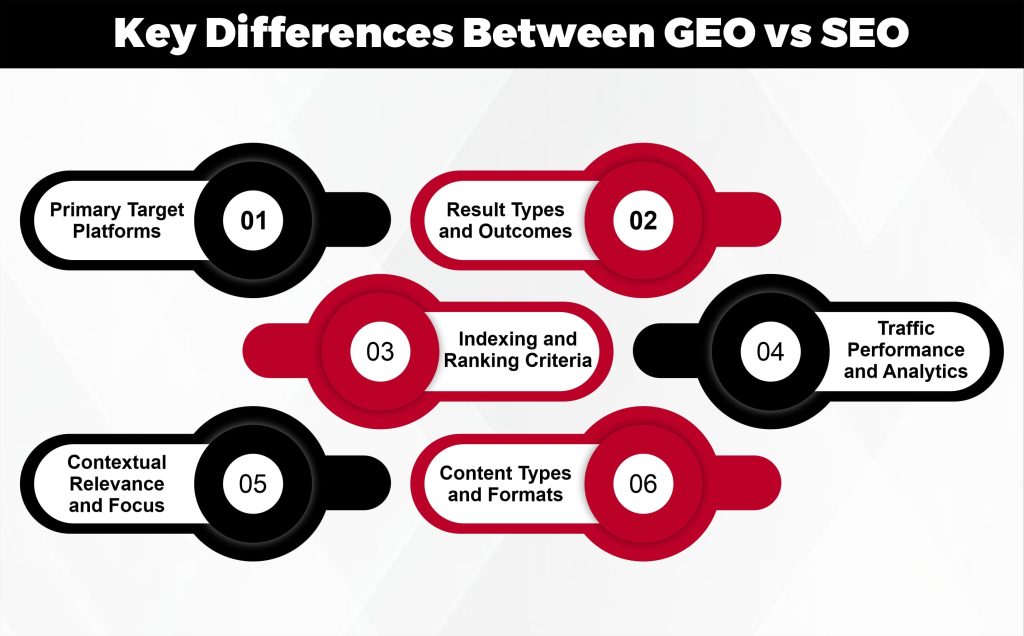
Key Differences Between GEO vs SEO
Businesses that want to do well in modern search need to know the difference between GEO vs SEO. Both strategies want to make things more visible, but they do so in different ways, on different platforms, and with different methods. Understanding these differences will help you make a marketing plan that works.
Primary Target Platforms
GEO vs SEO focus on different platforms when you compare them.SEO is mostly about search engines like Google and Bing, while GEO is more about AI-powered search engines and generative AI tools. SEO helps websites show up in organic search results, while GEO makes sure that content is recognized and shown as AI-generated answers.
Result Types and Outcomes
GEO vs SEO also differs in how results appear to users. SEO usually shows your website in search listings with links and snippets. GEO content, on the other hand, is designed to appear as direct answers in AI tools. This means users might get your content without visiting your website, improving brand visibility but requiring a different strategy for engagement.
Indexing and Ranking Criteria
Keywords, backlinks, page speed, and user experience are all important factors for SEO. GEO puts AI recognition, structured answers, and clarity at the top of its list. The main difference between GEO vs SEO is that GEO content is made to be understood by AI, not just to match keywords.
Traffic Performance and Analytics
You can use regular analytics tools to measure SEO traffic, which shows clicks, impressions, and how users act. GEO traffic may appear differently because users might see your answer without clicking. Businesses need to track AI visibility, answer engagement, and geo ranking metrics to measure success in seo to geo strategies.
Contextual Relevance and Focus
SEO is all about making sure that the content matches what users are looking for. GEO puts a lot of weight on context, clarity, and helpful answers so that AI tools can accurately understand and present your content. In GEO vs. SEO, GEO is more about giving information, while SEO is more about finding the right keywords and optimizing for ranking.
Content Types and Formats
Blogs, service pages, and structured content all work well with SEO. GEO works best with formats that are short, clear, and easy for AI to understand, such as FAQs, step-by-step guides, and direct answers.Using both strategies together makes sure that users can find your content on both traditional search engines and AI-powered platforms.
GEO and SEO Trends in 2026
Search is changing quickly, and businesses need to keep up to stay visible. If you know what GEO vs SEO will look like in the future, you can make plans that will work in 2026 and beyond. People are finding information in new ways thanks to AI-powered search and generative engines. For long-term growth, combining traditional SEO with GEO is becoming more and more important.
Rising Expertise Importance
In 2026, GEO vs SEO will be more about expertise and authority.Search engines that use AI put content that is trustworthy and has correct information at the top of the list. In both traditional SEO vs GEO results, businesses that show they know what they’re doing will rank higher. This means that making content that is useful and of high quality is more important than ever.
Zero-Click Search Growth
More and more people are doing zero-click searches, which means they get answers straight from search engines or AI tools without having to click on a website. This trend shows why GEO is becoming more important in the GEO vs. SEO debate. If you optimize your content for AI answers, people will see your brand even if they don’t go to your site directly.
Diversified Search Journeys
Search behavior is becoming more varied, including voice search, AI chat, and traditional typing queries. These different paths need to be taken into account when making GEO vs SEO plans. Companies that change their content to fit different formats, like FAQs, quick answers, and blog posts, will reach more people and stay ahead of the competition.
Conclusion
In today’s rapidly changing search landscape, any business that wants to grow online needs to know the difference between GEO vs SEO. SEO brings in steady traffic and long-term results, while GEO makes sure your brand is easy to find in AI-powered search results and gets ready for future search trends. Businesses can improve their geo ranking, build authority, and reach more users on many platforms by combining the two.
Our team of experts at Phoenix Dial helps service-based businesses figure out how to use GEO vs SEO strategies together. We offer solutions that get results, like making traditional search pages better and adding content that works well with AI. If you want to stay ahead in 2026 and get more people to see your business online, trust us to help you with GEO vs SEO.
To find out more about how our professional team can help you use the best SEO and GEO strategies for your business, go to our website Phoenix Dial.
FAQ’s
Is GEO replacing SEO?
No, GEO is not replacing SEO. Instead, it complements SEO by optimizing content for AI-powered search engines, while SEO continues to drive organic traffic from traditional search.
Is GEO going to replace SEO?
GEO will not replace SEO entirely. Both work together, as SEO focuses on website ranking and GEO ensures visibility in AI-generated answers and emerging search tools.
What is GEO in SEO?
GEO, or Generative Engine Optimization, is the practice of optimizing content so AI search engines can understand and display it as direct answers, enhancing your visibility alongside traditional SEO efforts.
What is SEO vs SEM vs GEO?
SEO improves organic search rankings, SEM (Search Engine Marketing) uses paid ads to gain traffic, and GEO focuses on AI-powered search optimization to appear in direct answers and AI tools.